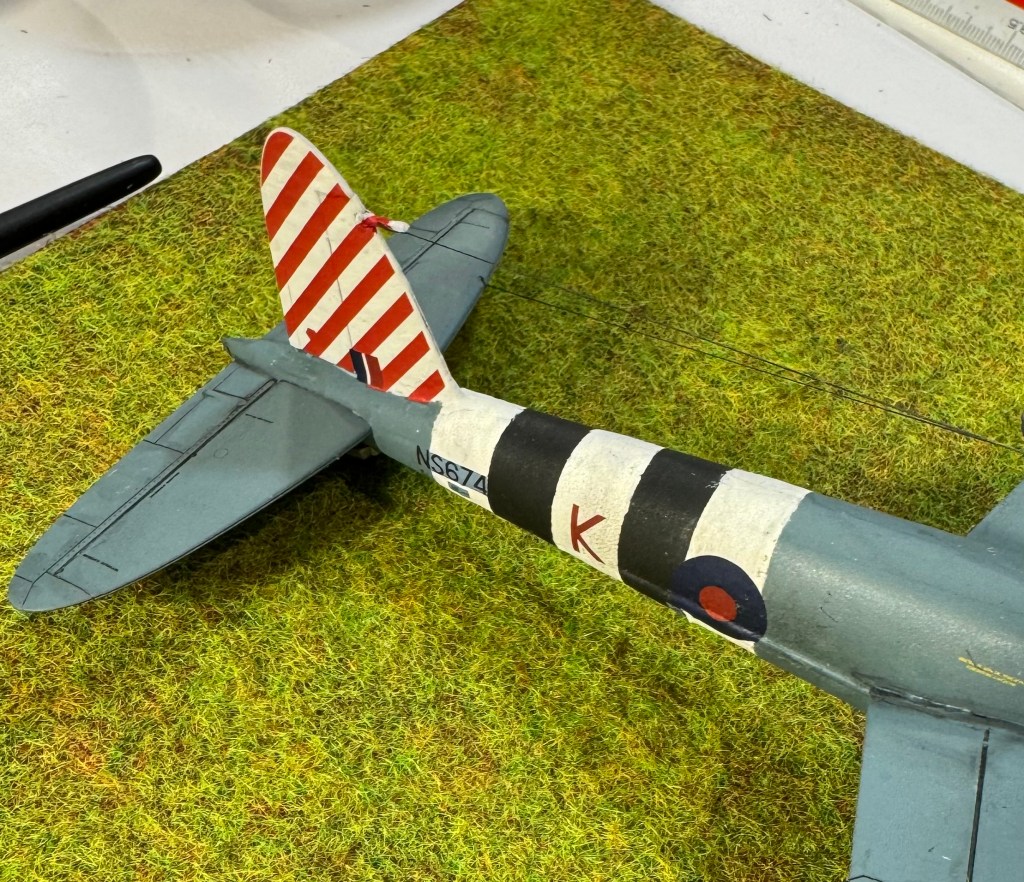
Airfix 1/72, De Havilland Mosquito, PR.XVI
This week is the 80th anniversary of D Day, 6th June 1944. On that day there was a potential problem. Lots of aircraft would be in the skies above the landing beaches. Who was friend? Who was foe? The solution was to paint 3 white and 2 black stripes around the rear fuselage of all allied planes. Wings could also be done as a secondary measure. The need for secrecy and concerns about the effectiveness of the modification, meant that the orders to paint the invasion stripes were not given until the evening of 3rd June. The orders specified 18-inch stripes for single engine planes and 24-inch stripes for larger dual engine aircraft. The original directive was to mask and mark out the stripes, but this proved impossible given the number of allied planes and the tight timeframes, especially since Operation Overlord was initially scheduled for the 4th June. In the end brooms and mops were the most common tools of application, often employed in near total darkness. The untidy results would not pass the expectation of modern small scale modelers, but form follows function. One month after D-Day the upper surface stripes were removed to make the aircraft less visible on the ground. All invasion stripes were ordered removed at the end of 1944, when the Allies had gained control of the European skies. #preparingtoflyintohell #letsmakelemonade
 Pen Paint and Scalpel