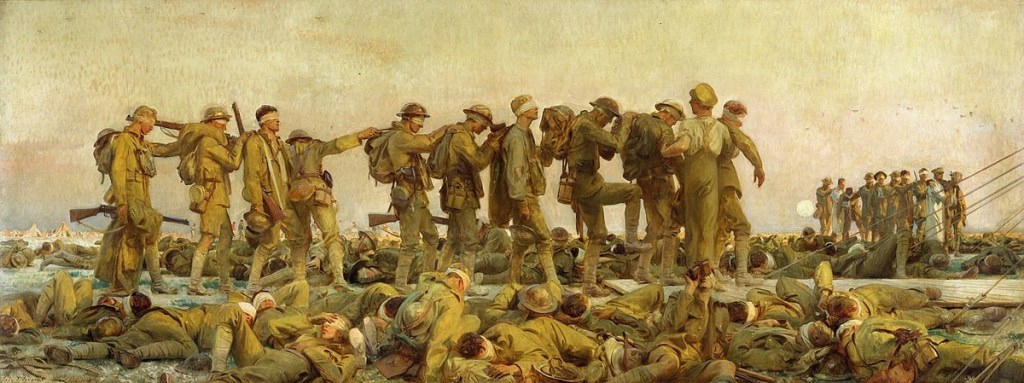
“Gassed”
John Singer Sargent, 1919, Imperial War Museum
In 1918 one of my heroes, John Singer Sargent, reluctantly accepted a commission to capture a major image for the planned Imperial War Museum. He felt out of his depth, he was a society portrait artist. As part of the agreement he insisted on visiting the front. Of all that Sargent encountered, the aftermath of a gas attack had the biggest impact on him. Mustard gas was a brutal enemy. On one day at Ypres 10,000 Allied troops were incapacitated in their own trenches without the firing a single shell or bullet. Mustard gas burnt skin, eyes, respiratory surfaces and sometimes killed without obvious cause, often days later. Just prior to WW2 the spectre of mustard gas lead to much Allied research. WWI autopsies had revealed an odd phenomenon, those that died after a gas attack had virtually no demonstrable myeloid white blood cells. This is devastating for frontline soldiers but if you had leukaemia it was hope. Modern chemotherapy started in 1946 with the use of cyclophosphamide — a cyclic ester of mustard gas, as the first treatment for CML. #theblindleadingtheblind #letsmakelemonade
 Pen Paint and Scalpel