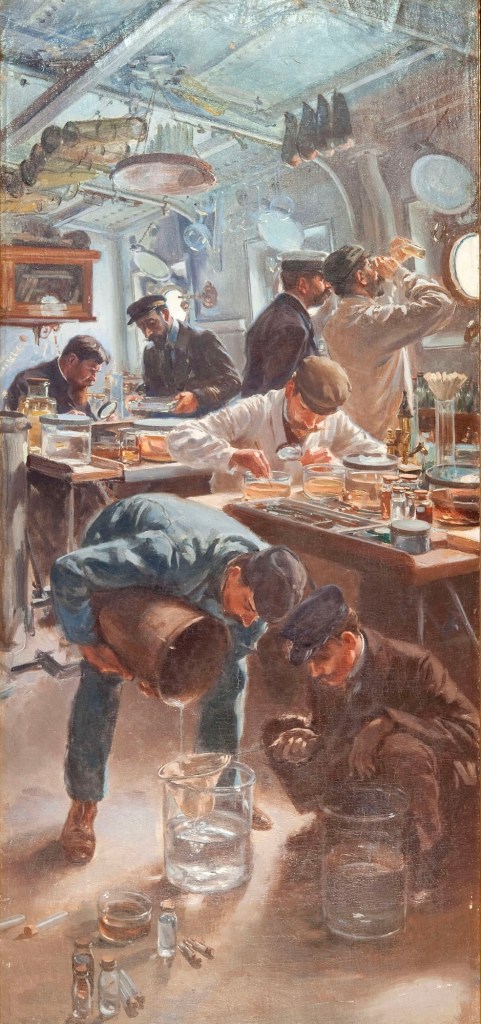
“Tableau le Labartoire sur Princess-Alice”
Louis Tinatyre
King Albert I of Monaco devoted much of his life and wealth to oceanography. In particular he led an annual exploration to the Azores on his yacht Princess-Alice. On board such trips were leading scientists in the relevant disciplines, as well as renowned chefs, artists, musicians and celebrities. Albert had noted during his voyages, that his crew were often impaired in their duties by stings from the local jellyfish, Physalia physalis. In the summer of 1902, a trip was undertaken with Charles Richet, Professor of Medicine from Paris on board.The goal was to isolate the jellyfish venom and develop a method of desensitisation. Guinea pigs, dogs and pigeons were exposed to the toxins collected, in the hope that initial small doses might lead to resistance from major toxicity, a popular contemporary theory known as phylaxis. In fact many of the exposed creatures showed no evidence of immunity, rather they became increasingly and often lethally sensitive. Richet described this new phenomenon as anaphylaxis. Charles Richet won the 1913 Nobel Prize in medicine for his work on the Princess-Alice. #stilllethalin2026 #letsmakelemonade

